
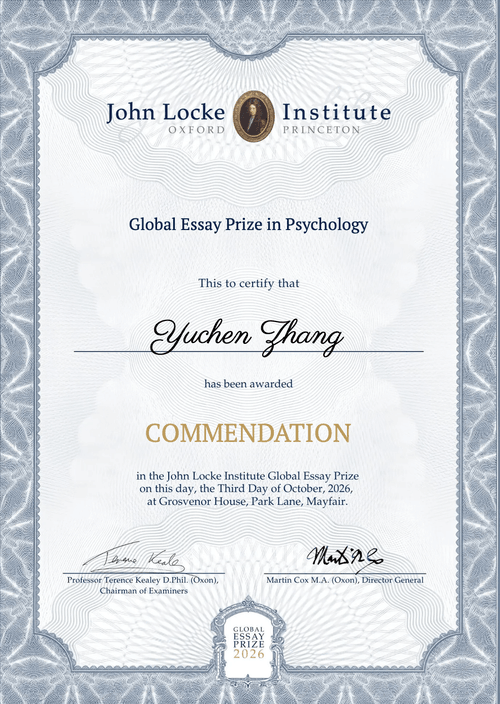
John Locke Essay Competition
I Received Commendation prize for 2026 competition, which is about the top 10% in all of the participants.
Perceiving Death Through the Body: From Disgust to Symbolic Immortality
In 2024, there are 47,180 deceased organ donors globally (Global Observatory on Donation and Transplantation, n.d.). Moreover, the body after death are protected by legal systems and institutions across nations and cultures. According to the Public Health (Control of Disease) Act (1984), local authorities have the duty to “bury or cremate” the body (s. 46). Such responses suggest that, although the deceased body possess no biomedical consciousness and no longer capable of subjective experience, people still express strong concern for the treatment and integrity of their own dead body and the deceased body of the broader human community. This raises a fundamental question: if the body no longer possesses awareness, why do people still care about posthumous body treatment after death? The body is placed in a state between objecthood and personhood, leading to psychological uncertainty. From evolutionary, cognitive identity, and meaning-making perspectives, people maintain a persistent concern for the body after death for three reasons: the evolutionary necessity to manage biological threats and existential terror; the cognitive process of constructing identity; and the body's meaning-making as the medium of symbolic immortality.
Evolutionary Avoidance and Existential Terror
The awareness of the dead body can be understood as an adaptive evolutionary response, which not only enables humans to manage the biological threats associated with the deceased body but also the existential terror that arises from the inevitable fate of death.
The human immune system helps to avoid potential sources of contamination, including dead bodies, which may carry infectious pathogens (Gan et al., 2022). Hence, the deceased body often elicit a feeling of disgust immediately, which relies on neurobiological mechanisms that respond to survival. Insular cortex, particularly the anterior insula, integrates sensory information related to contamination and generates visceral feelings of disgust. In an experiment conducted on both humans and monkeys, Wicker et al. (2003) identified that the insula can transform “unpleasant sensory input” into “visceromotor reactions” and accompany “feeling of disgust”. This indicates that the perception of the deceased body activates neural systems associated with disease avoidance, encouraging individuals to distance themselves from potentially dangerous somatic material.
While the care for the dead body originates from the pathogen avoidance and the response of disgust, human perception of a simultaneously forces individuals to think of inevitable biological death, and this consciousness of death exposes humans to a unique form of existential terror. Greenberg et al. (1997) explain that living people “necessitate the horrifying recognition” of their vulnerabilities and inevitable death; humans become aware not only of mortality itself, but also of the unpredictability and uncontrollability of death. Furthermore, Greenberg et al. point out the primary difference between humans and other creatures: humans have a “profoundly complex set of intellectual abilities” to mitigate the terror of death. The prefrontal cortex is associated with attention, planning and expression of emotions. It enables humans to recognize death as an inevitable end of the self. Species evolutionarily closer to humans possess more highly developed prefrontal cortical systems and also demonstrate more complex responses toward dead conspecifics (Semendeferi et al., 2001). In chimpanzees, infant bodies are “carried by females” and “transported and groomed” by males (Anderson, 2011), which indicates that the expansion of the frontal cortex provided an evolutionary foundation for more complex social and emotional responses to mortality.
Nevertheless, biological avoidance alone cannot explain why humans continue to treat the dead body with rituals and emotional significance long after immediate pathogens disappear. Humans internalize mortality as an inevitable future threat to the self, and developed elaborate burial rituals and symbolic practices surrounding the integrity of body after death. Archaeological evidence from Trinkaus and Buzhilova (2018) suggests that the bodies in the Sungir burials of Upper Paleolithic Russia were buried with “ivory beads”, “decorated clothing”, “spears”, and “red ochre”. The enormous investment of time and resources into these burials indicates that the dead were treated with ritual importance. From a Terror Management perspective, such rituals and social norms surrounding the dead body function as psychological buffers and protect individuals from existential anxiety and terror. As a result, such practices surrounding the dead body offer individuals a sense of meaning, continuity, and control over the inevitable mortality.
Taken together, the evolutionary process shapes both the biological and psychological mechanisms underlying concern for the dead body, and further leads to rituals and social norms surrounding the treatment of the body after death. These responses help humans reduce existential anxiety and maintain social stability.
Cognitive Cascade and Narrative Identity
Besides the terror of death itself, concern for the deceased body also reveals the role of the body as a carrier for the perception of death. Although individuals may accept death as inevitable, they are still reluctant to accept the physical insult and damage to the body after death, because encountering a damaged deceased body reminds them of their vulnerability and the possibility of having the same fate as the body they observed.
The Geneva Convention stipulates that military must “take all possible measures” to “search for the dead and prevent their being despoiled” (ICRC, 1949). Such protections are not merely humanitarian respect toward the deceased. They also function as a psychological mechanism to protect the mental well-being of the living by reassuring them that their own bodies will be preserved and protected, rather than abandoned or violated after death. Evidence from McNally (2003) suggests that traumatic experience, including perceiving bodily destruction and violation, can produce persistent psychological distress in the observers. The perception of the deceased body being harmed confronts observers with the fragility of their own bodily integrity and mortality.
When individuals cognitively associate their perception of the death of others and themselves, they may be increasingly aware of the vulnerability of their own body and lose the sense of security. From a psychoanalytic perspective, projection allows individuals to unconsciously attribute vulnerabilities to external objects or people to manage internal anxiety. When encountering a deceased body, individuals may associate the death of other people with their own potential fate, thereby imagining themselves being exposed to similar harm. Freud, A. (1936) argues that defense mechanisms protect the ego from overwhelming fear and psychological conflict. Neuroscience further provides a possible biological basis for these responses. Rizzolatti and Craighero (2004) suggest that “the activity of mirror neurons correlates with action understanding”. As a result, observing another individual’s dead body being damaged can unconsciously trigger learning towards the death experience in the neural system. This simulates feelings of fragility, pain, body damage, or other situations related to death experience within the observer’s own brain, causing individuals to mentally project the harm of the dead body onto themselves and experience emotional discomfort even without direct personal danger. Consequently, the dead body integrates projection by activating neural response and functions as a cognitive reflection. It forces individuals to confront their own embodied vulnerability, triggering a profound existential fear of mortality.
To cope with the existential terror triggered by potential violation of the body after death, humans gradually developed psychological mechanisms, which is the construction of narrative identity. According to McAdams and McLean (2013), people construct an “internalized and evolving life story” to integrate experiences into a coherent self-narrative (p. 233). Through narrative, individuals can position death as part of a meaning-making process in which they “learn something” or “glean a message from an event” (p. 234). For example, neurosurgeon Paul Kalanithi wrote When Breath Becomes Air during the final stage of his life to reconstruct death as part of a coherent self-narrative. Even after death, this narrative continues to affect the treatment of his body. Kalanithi was buried “on his own terms” (Kalanithi, 2016, p. 103). In this way, his body becomes the final expression of his identity and dignity, reflecting an integrated and comprehensive narrative identity. Research on meaning-making further shows that cognitive readjustment is necessary when individuals confront experiences that disrupt their broader beliefs and desires (Park, 2010).
While the body of living people serves as the subject of sensation and experience, the body after death becomes a physical object separated from consciousness. By constructing narrative identity, individuals can incorporate this future body into their current sense of self, maintaining symbolic continuity and psychological control over how their body will be treated after death. In this way, concern for the dead body maintains the dignity and continuity of the self after death.
Meaning-making and Symbolic Immortality
Narrative identity enables individuals to cognitively integrate death into a coherent life story and cope with anxiety surrounding the body after death from a cognitive perspective. According to Lifton et al. (1979), humans seek forms of “immortality” that transcend through different modes: biological continuation, creative contribution, experiential Transcendence, identification with nature, and religious belief. Rather than merely avoiding death, individuals attempt to preserve meaning and continuity beyond physical existence. Thus, while individuals may eventually accept that they may no longer control their body after death, they still resist the possibility of disappearing without symbolic meaning, trace, or continuous social memory. In this way, concern for the dead body reflects not only fear of death, but also the desire of humans to preserve identity, meaning and psychological continuity beyond death. The body serves as a physical medium through which symbolic meaning transcends the biological life.
Organ donation is a representative example to illustrate this process. According to the World Health Organization (World Health Organization, 2010, Guiding Principle 1), the moral emphasis on organ donation reflects the symbolic meaning of the human body after death. Vigilant and Williamson (2003) further argue that organ donation represents both biological and creative immortality. Although the donor dies physically, the organs continue to function in the recipient’s body and enable another human to survive. Through this continuation of the physical function of life, donors symbolically persist beyond mortality.
Admittedly, organ donation explains only part of people’s attitudes toward the posthumous body. Other individuals seek symbolic meaning through other forms. In many East Asian cultures, the body is understood as part of an ancestral lineage that passes through bloodlines across generations. They believe that the deceased family members remain symbolically present and interact with the living family members (Evans et al., 2024). Similarly, tombstones, ashes, and preserved items usually load the memory, allowing the dead to remain in social relationships. These practices vary according to the culture and belief system, but they all continue life in a symbolic way.
In fact, some individuals and traditions appear indifferent toward the preservation and treatment of the body after death. Tibetan sky burial, for example, ritually separates the body and feed them to vultures, embodying Buddhist principles of impermanence, compassion, and relationship with nature (Acharya, 2025). This clearly indicates that not all the ways of caring about the dead body are obviously linked to direct focus. However, even those treatments that seem completely indifferent to bodily preservation may represent one of the strongest expressions of symbolic immortality. Through the structured ritual of sky burial, individuals actively anticipate the destination of their deceased body and regain psychological control over the ultimate fate of their body. By redefining the relationship between the body and the spiritual meaning and broader universe, these traditions ultimately maintain a continuous symbolic life that transcends beyond the body.
Conclusion
Concern for the dead body originates from an evolutionary fear of contamination and mortality. This biological terror is further mediated by cognitive mechanisms and narrative identity, which enable individuals to psychologically regulate existential anxiety and maintain a sense of continuity of the self. Over time, these responses develop meaning-making processes that transform the dead body from physical remains into a medium of identity and symbolic immortality. Ultimately, the dead body occupies a deeply paradoxical position in human psychology: it serves as a reminder of biological vulnerability, and a cognitive matrix onto which humans project meaning, dignity, and the universal hope of transcending death. Although the body after deah is no longer alive biologically, it continues to possess psychological significance through the human tendency of projecting identity, memory, and symbolic meaning onto the dead body.
References
Acharya, S. (2025). Sky Burial in Upper Mustang: Cultural, Spiritual, and Ecological Perspectives on a Death Rituals in Nepal. International Research Journal of MMC, 6(4), 51–58. https://doi.org/10.3126/irjmmc.v6i4.85247
Anderson, J. R. (2011). A primatological perspective on death. American Journal of Primatology, 73(5), 410–414. https://doi.org/10.1002/ajp.20922
Evans, J., Cooperman, A., Starr, K. J., Corichi, M., Miner, W., & Lesage, K. (2024, June 17). Ancestor veneration, funerals and afterlife beliefs. Pew Research Center.
Freud, A. (1936). The ego and the mechanisms of defence. Hogarth Press.
Gan, X., Zhou, X., Li, J., Jiao, G., Jiang, X., Biswal, B., Yao, S., Klugah-Brown, B., & Becker, B. (2022). Common and distinct neurofunctional representations of core and social disgust in the brain: Coordinate-based and network meta-analyses. Neuroscience & Biobehavioral Reviews, 139, 104553. https://doi.org/10.1016/j.neubiorev.2022.104553
Global Observatory on Donation and Transplantation. (n.d.). WHO-ONT global observatory on donation and transplantation.
Greenberg, J., Solomon, S., & Pyszczynski, T. (1997). Terror management theory of self-esteem and cultural worldviews: Empirical assessments and conceptual refinements. Advances in Experimental Social Psychology, 29, 61–139. https://doi.org/10.1016/S0065-2601(08)60016-7
International Committee of the Red Cross. (1949). Convention (I) for the amelioration of the condition of the wounded and sick in armed forces in the field, Article 15 – Search for casualties. Evacuation. ICRC Database. https://ihl-databases.icrc.org/en/ihl-treaties/gci-1949/article-15
Kalanithi, P. (2016). When breath becomes air. Random House.
Lifton, R.J. (1979). The broken connection : on death and the continuity of life.
McAdams, D. P., & McLean, K. C. (2013). Narrative identity. Current Directions in Psychological Science, 22(3), 233–238. https://doi.org/10.1177/0963721413475622
McNally, R. J. (2003). Remembering trauma. Belknap Press of Harvard University Press.
Park, C. L. (2010). Making sense of the meaning literature: An integrative review of meaning making and its effects on adjustment to stressful life events. Psychological Bulletin, 136(2), 257–301. https://doi.org/10.1037/a0018301
Public Health (Control of Disease) Act 1984, c. 22. (1984). https://www.legislation.gov.uk/ukpga/1984/22
Rizzolatti, G., & Craighero, L. (2004). The mirror-neuron system. Annual Review of Neuroscience, 27, 169–192. https://doi.org/10.1146/annurev.neuro.27.070203.144230
Semendeferi, K., Armstrong, E., Schleicher, A., Zilles, K., & Van Hoesen, G. W. (2001). Prefrontal cortex in humans and apes: A comparative study of area 10. American Journal of Physical Anthropology, 114(3), 224–241. https://doi.org/10.1002/ajpa.1022
Trinkaus, E., & Buzhilova, A. P. (2018). Diversity and differential disposal of the dead at Sunghir. Antiquity, 92(361), 7–21. https://doi.org/10.15184/aqy.2017.223
Vigilant, L. G., & Williamson, J. B. (2003). Symbolic immortality and social theory: The relevance of an underutilized concept. In Handbook of death and dying (pp. 173–182). SAGE Publications. https://doi.org/10.4135/9781412914291.n18
Wicker, B., Keysers, C., Plailly, J., Royet, J.-P., Gallese, V., & Rizzolatti, G. (2003). Both of us disgusted in my insula: The common neural basis of seeing and feeling disgust. Neuron, 40(3), 655–664. https://doi.org/10.1016/S0896-6273(03)00679-2
World Health Organization. (2010). WHO guiding principles on human cell, tissue and organ transplantation. https://apps.who.int/iris/handle/10665/341733