
Online Mourning and Adolescents’ Death Perception Research
Traditionally, death has been encountered through physical space and cultural practices, such as funerals and family rituals. However, with the development of social media, people now can announce the death of their close ones or celebrities on varies social media, showing grief and remembrance of the deceased online. Meanwhile, mourning is expressed through online comments, posts, images and interactions. This behavior is defined as online mourning, and it provide people with direct access to mourning and grief. This may to some extend affect internet users, especially adolescents, who use social media frequently and are in the stage of rapid brain development.
The concern is that when adolescents perceive that information, will their emotional response changed? Possible changes may include increased death anxiety (anxiety caused by thoughts of one's own death) and reduced empathy (the general ability to perceive another person's perspective). Although I cannot yet assume all the changes are negative, but it is essential to prevent psychological harm. Therefore, understanding such changes is significant because social media has made death more imminent to adolescents’ everyday experience.
My research focuses mainly on death psychology and cyber psychology. While death psychology examines how people understand and respond to death, cyber psychology is a new found subject that investigate people’s behavior and cognition within online environment. Studying online mourning through both perspectives provide insight into how the digital environment shapes adolescents’ emotional change towards death and grief.
Existed conversation of online mourning suggests three important points to consider. First, the significance of cultural background can significantly affect people’s response. Marín-Cortés et al. (2023) found that members of Facebook mourning groups receive emotional validation through supportive interactions, but their study was conducted in a Latin American, Spanish-speaking context with strong religious influences. Similarly, Cupit et al. (2021) directly mentions visual content (iconography) of grief posting on social media, with a cross-cultural comparison between Italians and Americans, showing that visual expressions of grief can serve purposes such as remembering the deceased, maintaining continuing bonds, and expressing emotions. These findings suggest that online mourning should be understood within its specific cultural context rather than treated as a universal behavior.
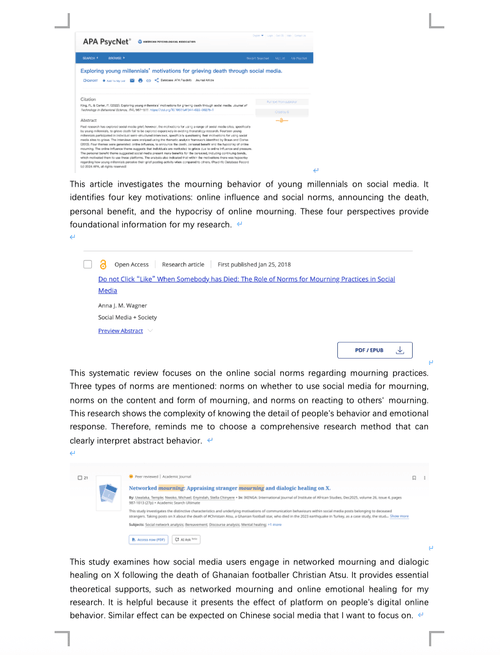
Second, social factors play a role in online mourning behavior. King and Carter (2022) suggest four key motivations in online mourning events: online influence and social norms, announcing the death, personal benefit, and the hypocrisy of online mourning. This indicates social psychological factors as an important factor in the online mourning process. Wagner (2018) also demonstrates social norms in online mourning context, and cautions about making conclusion out of online community feature.
Third, non-textual information is an effective indicator of online mourning behavior.
Cupit et al. (2021) specifically examined visual expressions of grief and found that photographs can communicate emotional expression effectively. Marín-Cortés et al. (2023) also highlights the importance of interactions within comment sections, suggesting that information beyond the original post can contribute to the emotional response.
However, most of the research are within western countries like the United States, Italy, and Latin American communities (Cupit et al., 2021; Marín-Cortés et al., 2023). As mentioned before, cultural background is a key factor that can influence people’s online mourning behavior, so individual research base on local Chinese online community is needed. Moreover, most of the research does not view adolescents as a special population to investigate. King and Carter (2022) focus on millenniums, while other research mainly use adults for population. This leave adolescents’ emotional response to online mourning behavior unknown. These gaps indicate that it is necessary to consider both the Chinese social media and the adolescents group.
Cupit, I. N., Sapelli, P., & Testoni, I. (2021). Grief iconography between Italians and Americans: A comparative study on how mourning is visually expressed on social media. Behavioral Sciences, 11(7), Article 104. https://doi.org/10.3390/bs11070104
King, R., & Carter, P. (2022). Exploring young millennials' motivations for grieving death through social media. Journal of Technology in Behavioral Science, 7(4), 567–577. https://doi.org/10.1007/s41347-022-00275-1
Marín-Cortés, A., Acosta, S., Gómez, F., García, A., & Quintero, S. (2023). Identification and validation of grief in Facebook groups on mourning. Cyberpsychology: Journal of Psychosocial Research on Cyberspace, 17(1), Article 4. https://doi.org/10.5817/CP2023-1-4
Wagner, A. J. M. (2018). Do not click "like" when somebody has died: The role of norms for mourning practices in social media. Social Media + Society, 4(1), 1–11. https://doi.org/10.1177/2056305117744392